 math
Ratios and Proportions: Scaling Recipes, Mixes and Maps
The best cook I know doesn't use recipes for the things she makes often — she uses ratios. Rice is one part grain to two parts water, vinaigrette is three parts oil to one part vinegar, and she scales both effortlessly for two people or twenty. Watching her, I realised that ratios and proportions aren't a school topic you leave behind; they're a genuinely useful everyday tool, and most people just never had them explained plainly.
Here's the plain version, with the one trick that unlocks all of it.
Ratios vs proportions
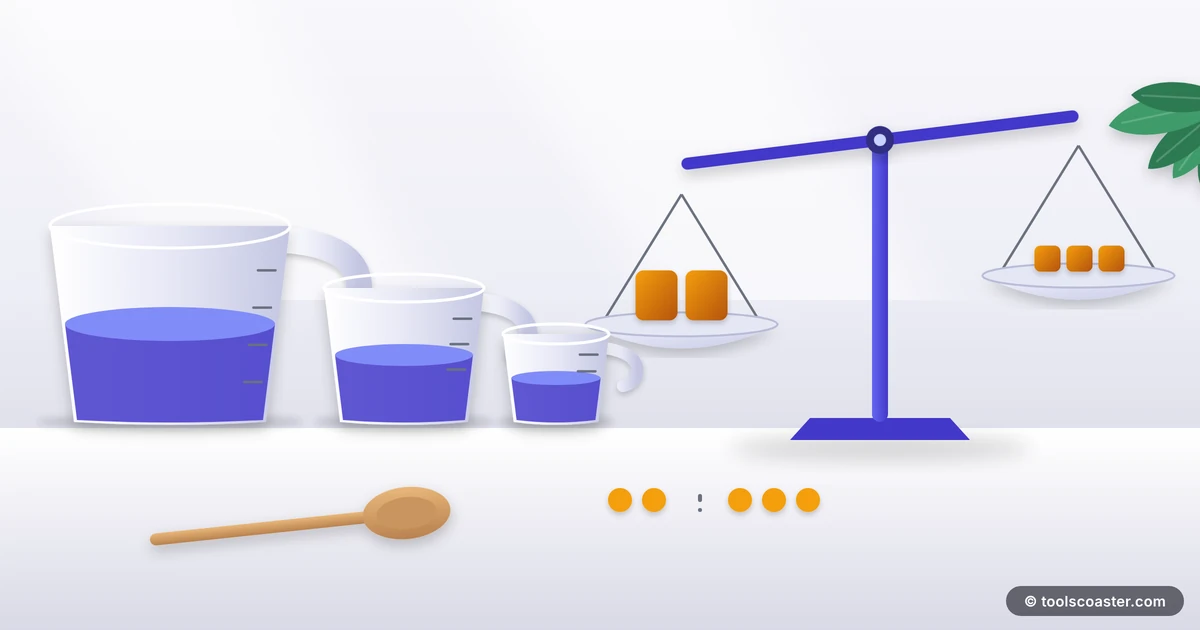
A ratio compares two quantities. "Two parts flour to one part water" is a ratio, written 2:1. It doesn't fix the amounts — it fixes the relationship. You could use 2 cups to 1 cup, or 2 kilos to 1 kilo; both are 2:1.
A proportion says two ratios are equal. If 2:3 and 4:6 describe the same relationship (and they do — both reduce to 2:3), that's a proportion. Proportions are where the power lies, because when you know three of the four values, you can always find the fourth.
The one trick: cross-multiplication
Almost every real proportion problem is "I know three numbers, what's the fourth?" The method that solves them all is cross-multiplication.
Write the proportion as two equal fractions: a/b = c/x. Multiply across the equals sign — a × x = b × c — then divide to isolate x. That's it. One technique, endless applications.
Say a recipe serves 4 and uses 300g of pasta, and you're cooking for 7. Set up 4/300 = 7/x, cross-multiply (4x = 300 × 7 = 2100), divide (x = 525g). You need 525g. A ratio calculator does this instantly, including the awkward fractions, but knowing the method means you understand why the number is right.
Scaling recipes (and everything like them)
Recipes are the friendliest example, but the same move handles anything that keeps a fixed relationship:
- Cooking: scale every ingredient by the same factor. To triple a recipe, multiply each quantity by 3; the ratios stay intact, so it still tastes right.
- Mixing: fuel-to-oil for a two-stroke engine, paint tints, cleaning concentrates — all specified as ratios you scale to the batch size you need.
- Maps and models: a scale of 1:25,000 means 1 cm on the map is 25,000 cm in reality. Cross-multiply to turn map distance into real distance.
- Money: currency conversion and unit pricing ("which pack is cheaper per 100g?") are proportions in disguise.
A quick worked example
A vinaigrette is 3 parts oil to 1 part vinegar, and you have 50ml of vinegar to use up. How much oil? Set 3/1 = x/50, cross-multiply (x = 3 × 50 = 150), so 150ml of oil. The ratio held; you just scaled it to the vinegar you had. Flip the question — you have 180ml of oil, how much vinegar — and the same method gives 60ml. One technique, both directions.
Where people slip up
Two mistakes cause most ratio errors.
The first is adding instead of scaling. If a recipe is 2:1 and you want more, you don't add the same amount to each — you multiply both by the same factor. Adding changes the ratio and ruins the result.
The second is mismatched units. A proportion only works if the units line up on each side. Comparing grams to kilograms, or centimetres to metres, without converting first gives an answer that's off by a factor of a thousand. Keep units consistent, or convert before you cross-multiply.
For percentage-flavoured proportions — "15% of what number is 45?" — a percentage math tool or a percentage calculator handles the same underlying proportion with the percent built in.
A simple mental checklist
When a proportion problem lands in front of you:
- Write it as two equal fractions, keeping like units in like positions.
- Check the units match on both sides; convert if not.
- Cross-multiply and divide to find the missing value.
- Sanity-check the direction — if you scaled up, the answer should be bigger.
The takeaway
Ratios describe relationships, proportions set two of them equal, and cross-multiplication solves for whatever's missing. That single technique scales recipes, mixes fuel, reads maps and compares prices — it's one of the highest-return bits of everyday math there is. Keep the units consistent, scale rather than add, and lean on a ratio calculator for the messy numbers. Do that and you'll start seeing proportions everywhere, and solving them without a second thought — just like a good cook.
Frequently Asked Questions
What's the difference between a ratio and a proportion?
A ratio compares two quantities (2:3). A proportion says two ratios are equal (2:3 = 4:6). Proportions let you solve for an unknown when you know the other three values.
How do I scale a recipe up or down?
Keep every ingredient in the same ratio. To triple a recipe, multiply each quantity by 3; to make two-thirds, multiply by 2/3. A ratio calculator handles awkward fractions for you.
How does cross-multiplication work?
For a/b = c/x, multiply across the equals sign: a × x = b × c, then solve for x. It's the fastest way to find a missing value in any proportion.
Explore 500+ Free Online Tools
No sign-up. No cost. Forever free — for developers, writers & creators.