 math
Prime Numbers, GCD and LCM: Number Theory Made Simple
Number theory has a reputation for being the most abstract corner of mathematics — the playground of academics with no bearing on daily life. That reputation is wrong. Every time you simplify a fraction, every time you make a secure online payment, and every time two repeating schedules line up, number theory is quietly at work. Primes, greatest common divisor and least common multiple are the three ideas that do most of that work.
Here is the plain-English version, with the practical uses that make them worth understanding.
Prime numbers: the atoms of arithmetic
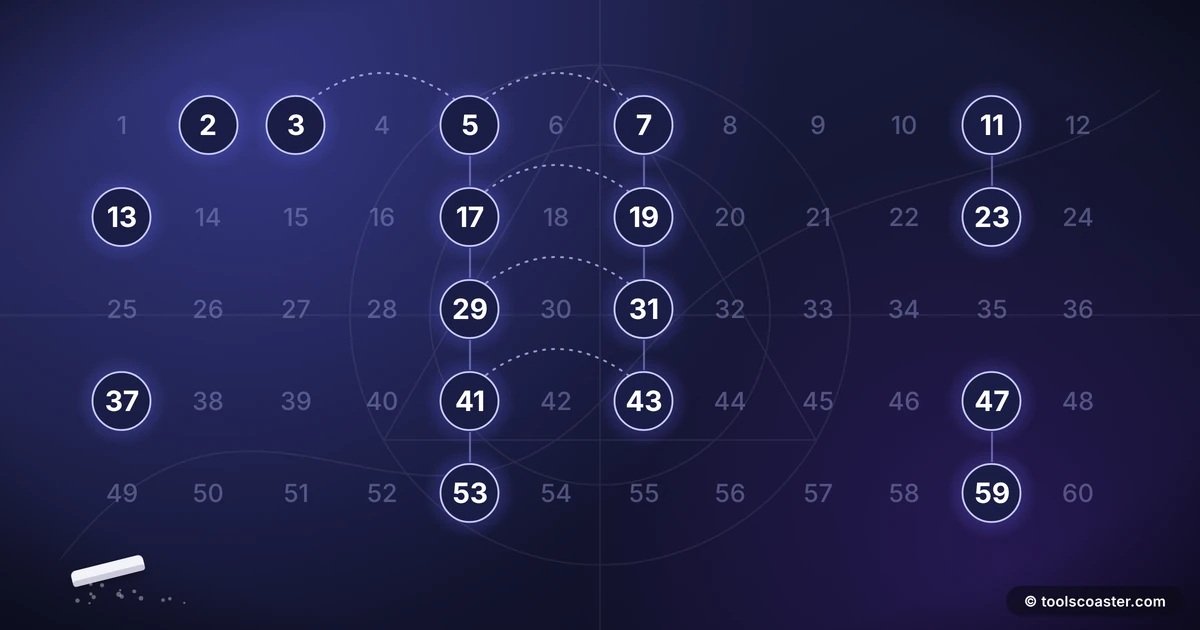
A prime number is a whole number greater than 1 that can only be divided evenly by 1 and itself. The sequence starts 2, 3, 5, 7, 11, 13, 17… Numbers that have other divisors — like 12, which splits into 2, 3, 4 and 6 — are called composite.
A couple of details surprise people. 2 is the only even prime — every other even number is divisible by 2, which disqualifies it. And 1 is not prime by definition, a convention that keeps the rest of number theory tidy.
Primes matter because they are the building blocks of all other numbers. Any whole number can be written as a unique product of primes — this is the fundamental theorem of arithmetic. 60, for instance, is 2 × 2 × 3 × 5, and no other combination of primes produces it. Checking whether a number is prime by hand gets tedious fast, so a prime number checker is the quick way to test one.
GCD: the key to simplifying
The greatest common divisor (GCD, sometimes called highest common factor) of two numbers is the largest number that divides both of them evenly. The GCD of 12 and 18 is 6, because 6 is the biggest number that goes into both.
The most common place you meet GCD without realising it is simplifying fractions. To reduce 18/24 to its simplest form, you divide top and bottom by their GCD, which is 6, giving 3/4. The same idea scales ingredient ratios, simplifies aspect ratios, and reduces any proportion to its cleanest form. A GCD calculator finds it instantly, which saves a lot of trial and error on larger numbers.
One elegant way to find the GCD is the Euclidean algorithm: repeatedly replace the larger number with the remainder of dividing the two, until the remainder is zero. The last non-zero value is your GCD. It is over two thousand years old and still the method computers use today.
LCM: the key to lining things up
The least common multiple (LCM) is the mirror image of GCD: the smallest number that both values divide into. The LCM of 4 and 6 is 12, because 12 is the first number that appears in both the 4-times and 6-times tables.
LCM answers "when do cycles coincide?" questions. If one bus comes every 4 minutes and another every 6, both arrive together every 12 minutes — that is the LCM. Adding fractions needs it too: to add 1/4 and 1/6 you convert both to twelfths (the LCM of the denominators), giving 3/12 + 2/12 = 5/12. An LCM calculator does the heavy lifting for bigger numbers.
There is a neat relationship worth remembering: for any two numbers, GCD × LCM = the product of the numbers. For 4 and 6, GCD is 2, LCM is 12, and 2 × 12 = 24 = 4 × 6. Knowing one lets you find the other.
A quick worked example
Suppose you are splitting 18 red and 24 blue tokens into identical bundles with none left over. The number of bundles is the GCD of 18 and 24, which is 6 — so six bundles, each with 3 red and 4 blue. Flip the question to "how often do two blinking lights at 18 and 24 second intervals flash together?" and the answer is their LCM, 72 seconds. Same two numbers, two different tools, two different real answers.
Where this shows up in the real world
The surprising payoff of number theory is cryptography. Modern encryption like RSA relies on a simple asymmetry: multiplying two large primes together is easy, but taking the result and working backwards to find those primes is, for big enough numbers, practically impossible even for powerful computers. That one-way difficulty is what keeps your online banking and messaging secure. Every HTTPS padlock in your browser rests on properties of prime numbers.
Beyond cryptography, these ideas appear in:
- Hashing and data structures, where prime table sizes reduce collisions.
- Scheduling, where LCM predicts when repeating events align.
- Music and gears, where ratios and common multiples govern rhythm and mechanics.
- Everyday fractions and ratios, simplified using GCD.
The takeaway
Primes, GCD and LCM are not museum pieces. They are the quiet machinery behind simplified fractions, synchronised schedules and the encryption protecting everything you do online. You do not need to compute them by hand — a prime number checker, a GCD calculator and an LCM calculator give instant answers. What is worth carrying is the intuition: primes are indivisible building blocks, GCD breaks things down to their simplest shared form, and LCM finds where separate cycles meet. Those three ideas explain a startling amount of the world.
Frequently Asked Questions
What makes a number prime?
A prime number is greater than 1 and divisible only by 1 and itself (2, 3, 5, 7, 11…). Numbers with other divisors are composite. 2 is the only even prime.
What's the difference between GCD and LCM?
The greatest common divisor is the largest number that divides two values evenly; the least common multiple is the smallest number both divide into. GCD simplifies fractions; LCM finds common denominators.
Where are primes actually used?
Prime factorization underpins modern encryption (like RSA), because multiplying large primes is easy but factoring the result is extremely hard. Primes also appear in hashing and scheduling problems.
Explore 500+ Free Online Tools
No sign-up. No cost. Forever free — for developers, writers & creators.