 writing
Writing Product Descriptions That Actually Sell
I once watched two listings for nearly identical products sell at wildly different rates. The slow one listed specifications like a datasheet. The fast one opened with a single line about what the product would do for you by the weekend. Same item, same price — the difference was entirely in the words. A product description isn't a spec sheet; it's a tiny piece of persuasion, and a few simple principles separate the ones that sell from the ones that sit.
Here's the framework I use, and where tools help.
The one shift: benefits before features
The most important move in product copy is leading with the benefit, not the feature. A feature is what the product is; a benefit is what it does for the buyer.
"5,000 mAh battery" is a feature. "Lasts all day on one charge" is the benefit. "Merino wool blend" is a feature. "Stays warm without the itch" is the benefit. Buyers don't want a battery or a fabric — they want the outcome. Lead with the outcome, then let the feature back it up as proof.
This doesn't mean dropping specs. It means ordering them: benefit first to earn attention, feature second to earn belief.
A simple framework
Good descriptions tend to follow the same shape:
- Open with the key benefit — the single most compelling thing the product does for the buyer. This is your headline.
- Back it with specifics — the features and specs that prove the benefit is real. Concrete beats vague every time.
- Answer the obvious objection — the one worry that stops the sale (durability, sizing, compatibility). Name it and resolve it.
- Close with a clear call to action — tell the buyer exactly what to do next.
That's it. Benefit, proof, objection, action. A product description generator can give you a first draft in this shape to react to, and a call-to-action generator helps sharpen that closing line.
A quick worked example
Take a plain listing: "Stainless steel water bottle. 750ml. Double-walled. BPA-free." Rewrite it with the framework: "Cold water from breakfast to dinner — this double-walled steel bottle keeps drinks icy for 24 hours. The 750ml size covers most of your day, it's fully BPA-free, and the leak-proof lid means you can toss it in a bag without a second thought. Add one to your order and stop buying plastic." Same facts, but now they're arranged around what the buyer gets, with the objection (leaks in a bag) handled and a clear next step. That reordering is most of the work.
Write specific, scannable copy
Two style habits lift almost any description:
Be specific. "Long battery life" is weak; "lasts all day on one charge" is strong. "High quality" means nothing; "stitched, not glued, so the sole won't peel" means everything. Specific claims are believable and memorable; vague ones are noise.
Make it scannable. Online, people skim before they read. A wall of text gets skipped. Short paragraphs, a few bullet points for specs, and a clear benefit up top let a skimmer get the gist in seconds and decide to read more. Write for the glance first, the deep read second.
Using generators well
A product description generator is genuinely useful for beating the blank page — especially when you have dozens or hundreds of products to write and can't face starting each from zero. But the same rule applies as with any AI copy: the output is a starting draft, not a finished listing.
Generator copy tends to be generic and occasionally makes claims your product can't back. So always edit it: drop in your real specs, rewrite in your brand's voice, cut the hype, and make sure every claim is true. A headline analyzer can help you sharpen the opening benefit line, which is the part that does the most work. Use the tool to get something down fast, then make it specific, honest and yours.
A word on honesty
One principle underpins everything: don't oversell. A description that promises more than the product delivers wins the sale and loses the customer — returns, bad reviews and lost trust cost far more than the sale was worth. Persuasion and honesty aren't opposites; the most convincing copy is specific, confident and true. Sell the real benefit well, and you get buyers who stay happy.
The takeaway
A product description is persuasion in miniature, and the winning formula is simple: lead with the benefit, prove it with specific features, answer the obvious objection, and close with a clear call to action. Write specific and scannable, use a generator to break the blank page but always edit it into your real voice with your real facts, and never promise what the product can't deliver. Do that and your listings will start doing what the fast-selling one did — telling buyers, in their first glance, exactly why this is for them.
Frequently Asked Questions
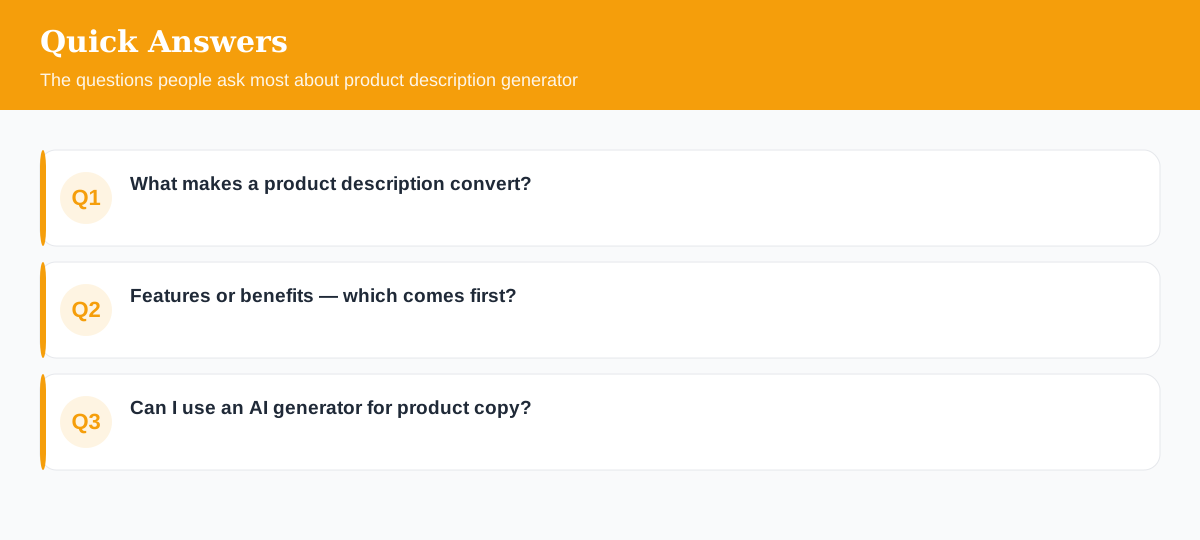
What makes a product description convert?
It leads with the benefit (what the product does for the buyer), supports it with concrete specs, answers the obvious objection, and ends with a clear call to action — all in scannable, specific language.
Features or benefits — which comes first?
Benefits. 'All-day battery' matters more than '5,000 mAh'. Lead with the outcome the buyer wants, then list the spec that proves it.
Can I use an AI generator for product copy?
Yes, to break the blank page and get options fast. Then edit for your real specs, brand voice and honesty — generator output is a starting draft, not a finished listing.
Explore 500+ Free Online Tools
No sign-up. No cost. Forever free — for developers, writers & creators.