 writing
Beat Writer's Block: Headlines, Bios and Copy with Generators
The hardest part of writing is almost never the writing. It is the blank page — that paralysing moment before the first word exists, when every option feels equally possible and equally wrong. I have stared at empty documents for an embarrassing length of time, and the thing that reliably breaks the spell is not willpower. It is having something in front of me to react to, even if it is bad. That is exactly what generators are good for.
Here is how I use headline, bio and copy generators to beat writer's block — and, importantly, how to use them without surrendering your own voice.
Why the blank page is so hard
Starting from nothing forces two difficult jobs at once: inventing ideas and judging them. Your brain tries to generate and critique simultaneously, and the critic usually wins, vetoing every fragile early idea before it is fully formed. The result is paralysis.
The fix is to separate generation from editing. Get options onto the page first, without judging them, then switch into editing mode and shape what is there. Editing is a far easier cognitive task than inventing — most people are much better at improving a draft than conjuring one. Generators simply handle that first, awkward generation step for you.
Headlines: your highest-leverage words
A headline does a disproportionate amount of work. It decides whether anyone reads the rest, whether a post gets clicked in search results, whether an email gets opened. Agonising over a blank headline field is common — and unnecessary.
A blog title generator gives you a batch of angles on your topic in seconds. You will not use most of them verbatim, and that is fine. Their job is to spark: one option suggests a "how-to" angle, another a "mistakes to avoid" angle, a third a number-led list. Suddenly you are choosing and refining instead of inventing from zero.
What makes a headline actually work:
- Specificity. "7 Budgeting Tips" beats "Some Money Advice". Concrete details earn trust.
- A clear benefit. Tell the reader what they get by clicking.
- Matched intent. The headline must deliver on its promise, or you lose the reader instantly and permanently.
Once you have a shortlist, a headline analyzer can score them on length, word balance and sentiment, helping you pick the strongest. For search specifically, a title optimizer checks that your title fits within the length Google displays and leads with your keyword.
A quick worked example
You are writing about meal planning and the title field is blank. Generate a batch and you might get "How to Meal Plan for a Busy Week", "5 Meal-Prep Mistakes That Waste Food", and "The Lazy Person's Guide to Meal Planning". None is perfect, but now you have raw material: combine the specificity of the second with the voice of the third, and you land on "5 Meal-Prep Mistakes Busy People Make (and Easy Fixes)". You edited your way there in thirty seconds instead of staring for ten minutes.
Bios: the hardest short writing there is
Writing about yourself in a few lines is weirdly difficult — the brevity and the self-focus combine into a special kind of stuck. A bio generator gives you a serviceable structure to react to: a first line establishing who you are, a second on what you do, a third with a human detail. You then swap in your real specifics and your actual voice. Starting from a template beats starting from a blinking cursor every time, and you end up editing rather than agonising.
Using generators without losing your voice
This is the part that matters, so let me be direct: generators give you raw material, not finished writing. Publishing generator output as-is is a mistake. It reads generic, it sounds like everyone else, and readers can feel it.
The right workflow treats the output as clay:
- Generate a batch of options to break the blank page.
- Select the one or two with genuine promise.
- Rewrite them in your own voice, with your specifics, your examples, your personality.
- Cut anything that sounds like filler or hype.
The generator solved the hardest 10% — getting something down. The remaining 90% — making it genuinely yours — is still your job, and it is where the quality lives.
A note on power words
Generators often lean on "power words" — curiosity- or value-triggering words that can lift engagement. Used sparingly, inside otherwise clear and honest copy, they help. Overused, they read as spam and erode trust. A headline stuffed with "ultimate", "insane", "secret" and "guaranteed" screams low quality. Sprinkle, do not saturate, and never promise something the content does not deliver.
The takeaway
Writer's block is a generation problem, not a willpower problem, and generators attack it exactly where it hurts. A blog title generator breaks the blank headline, a headline analyzer helps you choose the strongest, and bio and copy generators give you a structure to react to. The one rule that keeps the quality high: use the output as a starting point to edit, never as a finished product to publish. Get something down, then make it yours. The blank page loses its power the moment there are words on it — even imperfect ones.
Frequently Asked Questions
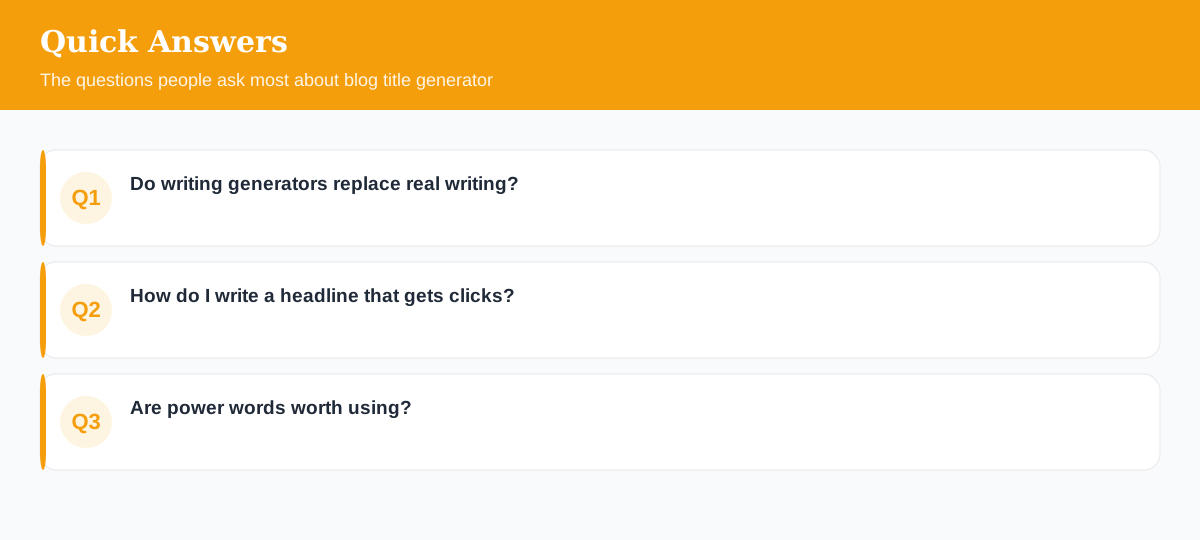
Do writing generators replace real writing?
No — they break the blank-page problem. They give you raw options to react to and refine. The best results come from editing generator output into your own voice, not publishing it as-is.
How do I write a headline that gets clicks?
Be specific, lead with a clear benefit, and match the reader's intent. Generate several options, then pick the one you'd genuinely click. A headline analyzer can score your shortlist.
Are power words worth using?
Used sparingly, yes — words that evoke curiosity or value can lift engagement. Overused, they read as spam. Sprinkle them into otherwise clear, honest copy.
Explore 500+ Free Online Tools
No sign-up. No cost. Forever free — for developers, writers & creators.