 security
Password Strength and Entropy: How Secure Is Your Password Really?
Everyone has been nagged to use a "strong password", but almost nobody is told what strong actually means. The result is a world full of passwords like P@ssw0rd! that feel secure and are not. Once you understand how cracking really works, the advice that matters becomes obvious — and it is simpler than the rules most sites enforce.
This guide explains what makes a password strong, why length beats complexity, and how entropy and crack-time estimates work.
How passwords are actually cracked
Attackers rarely sit there typing guesses. When a site is breached, they steal a database of scrambled (hashed) passwords and run software that tries billions of candidates per second against it, offline. Two strategies dominate:
- Dictionary attacks try known words, common passwords and predictable patterns first — including the "clever" substitutions like
@foraand0foro. - Brute force tries every possible combination, starting with short ones.
The implication is key: a password's strength is about how many guesses it survives, not how complicated it looks to you.
Why length beats complexity
Here is the uncomfortable truth about P@ssw0rd!. It satisfies every "complexity" rule — upper, lower, number, symbol — yet it is weak, because it is built from a common word with predictable substitutions that cracking tools expand automatically.
Now compare a passphrase like correct horse battery staple. It is all lowercase letters and spaces, no symbols at all, yet it is far stronger, because its length creates an astronomical number of possibilities. Each additional character multiplies the guesses an attacker needs.
This is why modern guidance (including from security agencies) has shifted: favour long, memorable passphrases over short strings of random symbols. They are stronger and easier to remember.
You can see the effect directly with a password strength checker, which rates a password and shows which factors help.
Entropy: measuring unpredictability
Security people measure password strength in bits of entropy. Entropy estimates how unpredictable a password is: each extra bit doubles the number of guesses required.
A rough sense of the scale:
- Under 28 bits: very weak — cracked almost instantly.
- 28–50 bits: weak to moderate.
- 60–80 bits: reasonable for most accounts.
- 100+ bits: strong, suitable for high-value secrets.
Entropy comes from two things: the size of the character pool and the length. Length is the lever you control most easily — which is exactly why long passphrases win. A password entropy tool estimates the bits for any candidate.
Crack-time estimates in context
Tools that show "time to crack" translate entropy into something intuitive — seconds, days, or billions of years. Treat these as relative guides, not promises. They assume a certain guessing speed, and real attackers vary.
Still, the comparison is illuminating. A short password might show "cracked instantly" while adding four more words pushes it to "centuries". Use a brute-force time estimate to feel the difference length makes, then act on it.
How attackers actually get in
Password strength only addresses one attack — guessing. In the real world, most account takeovers happen through weaknesses that a strong password alone does not fix, which is why the habits in the next section matter so much.
- Credential stuffing. When one site is breached, attackers take the leaked email-and-password pairs and try them on hundreds of other sites. If you reused that password, your other accounts fall instantly, no "cracking" required. This is why unique passwords matter more than raw strength.
- Phishing. A convincing fake login page harvests your password directly, however strong it is. The defence is vigilance about where you type credentials — and multi-factor authentication, which blunts a stolen password.
- Data breaches. Even a perfect password is exposed if the service storing it is compromised and stored it badly. You cannot control their security, only limit the blast radius by not reusing the password elsewhere.
Why reuse is the real villain
Notice the pattern: the biggest risks are not about one password being weak, but about one password unlocking many doors. A long, unique password per site contains the damage of any single breach to that one account. That is the single most important habit, ahead of adding more symbols to a password you reuse everywhere.
Practical habits that actually protect you
Strength is only half the battle. How you manage passwords matters just as much.
- Use a unique password per site. Reuse is the single biggest real-world risk — one breach then unlocks everything.
- Prefer long passphrases of four or more random words for anything you must memorise.
- Use a password manager to generate and store long random passwords for everything else, so you only remember one strong master passphrase.
- Turn on multi-factor authentication wherever it is offered. Even a cracked password is far less useful without the second factor.
- Never test your real live password in any tool that is not fully client-side. Prefer checkers that run in your browser and upload nothing — and as a habit, test a representative sample rather than the exact password you use.
The takeaway
Strong passwords are not about cramming in symbols — they are about length and unpredictability. A long passphrase beats a short complex string on both security and memorability, and entropy is the number that explains why. Pair long unique passwords with a manager and multi-factor authentication, and you have covered the vast majority of real risk. Check a candidate with a password strength checker to see these principles in action before you commit to it.
Frequently Asked Questions
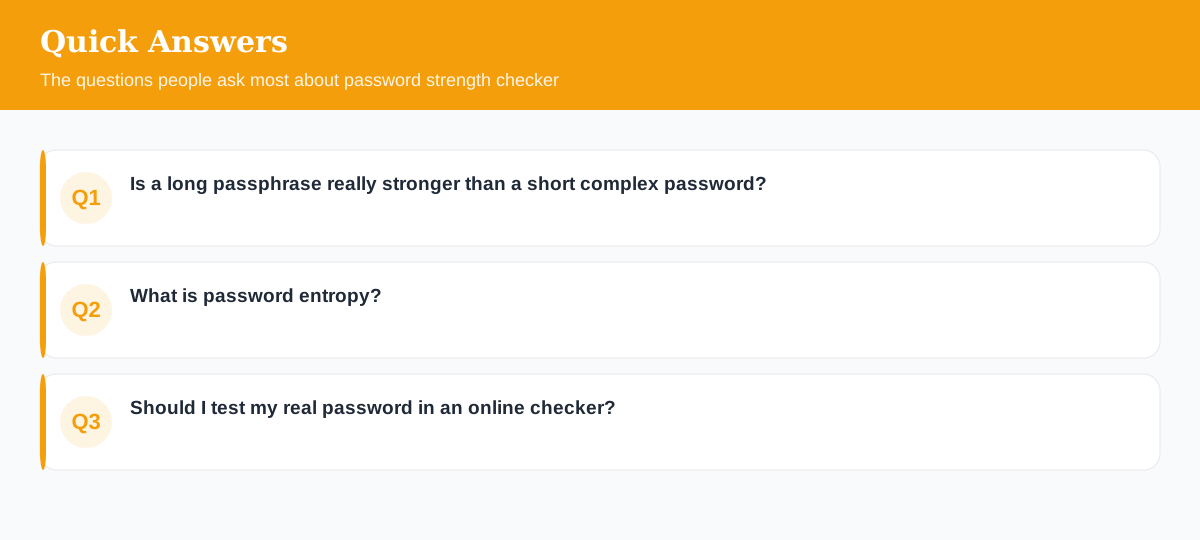
Is a long passphrase really stronger than a short complex password?
Usually yes. Each extra character multiplies the number of guesses needed, so a long memorable passphrase often beats a short string of random symbols — and it's easier to remember.
What is password entropy?
Entropy, measured in bits, estimates how unpredictable a password is. More bits means exponentially more guesses to crack it. Above about 60 bits is reasonable; above 100 is strong.
Should I test my real password in an online checker?
Use a client-side checker that never uploads your input, and as a habit test a similar sample rather than your exact live password.
Explore 500+ Free Online Tools
No sign-up. No cost. Forever free — for developers, writers & creators.