 fun
Dice, Coins and Spinners: Randomizers for Game Night
Game night at my place has a recurring crisis: we open the board game and a die is missing. It has rolled under the sofa, vanished into a different box, or simply ceased to exist. For years this derailed things until someone pulled out a phone, opened an online dice roller, and we never looked back. Online randomizers — dice, coins and spinners — have quietly become the thing that keeps game night (and plenty of small decisions) moving.
Here's why they're so handy and when each one shines.
The humble randomizer, upgraded
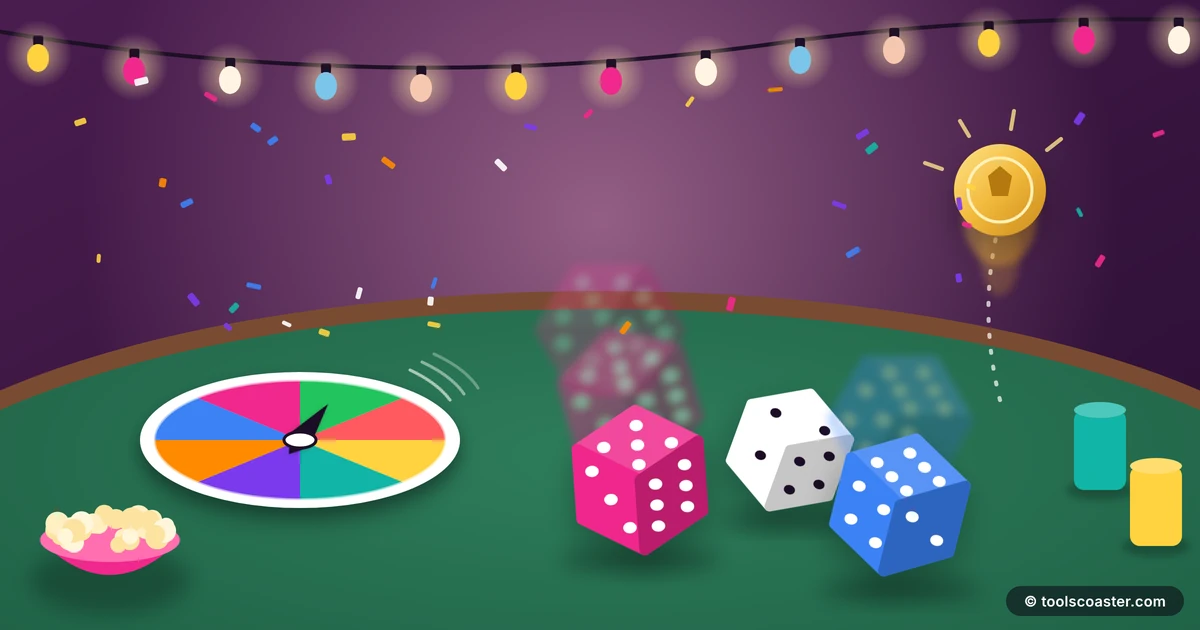
Dice, coins and spinners all do one thing: produce a fair, unpredictable outcome. They've been settling games and arguments for thousands of years. The online versions add three modern perks: you can't lose them, you can't misplace them under the sofa, and they can do things physical ones can't — like rolling ten dice at once or putting custom options on a wheel.
They're not replacing the tactile joy of real dice for a dedicated tabletop group. But for a missing die, a quick decision, or a classroom, they're faster and more reliable than hunting for the real thing.
Dice: more than six sides
An online dice roller covers the obvious case — a standard six-sided die for board games — but its real advantage is flexibility. You can roll multiple dice at once and get the total instantly, which is a genuine time-saver for games that have you rolling three or four dice a turn. And for tabletop role-playing games, it handles the full set of dice (d4, d8, d12, d20 and more) that you'd otherwise need a whole pouch to carry.
No arithmetic errors adding up a handful of dice, no searching for the d20 that rolled off the table — just the result.
Coins: the pure two-way call
When the choice is binary — this or that, yes or no, who kicks off — nothing beats a coin flip. A coin flipper gives you the fastest possible fair decision between two options, with the familiar ritual of heads or tails. It's the right tool when a wheel would be overkill and you just need one of two outcomes, settled instantly and visibly fairly.
Spinners: group choices made visible
A wheel spinner is the one to reach for when you have several named options and a group that needs to agree. Type in the choices — restaurants, team names, raffle entries, students — and spin. The magic is that everyone watches it land, so the outcome is transparently fair. No one can accuse the spinner of favouritism the way they might quietly suspect a person who "just picked."
That visible fairness is why wheel spinners are so popular in classrooms (picking who answers), giveaways (drawing a winner), and any group deciding among several options.
A quick worked example
Four friends can't agree where to eat. One types the four restaurants into a wheel spinner and spins it. It lands on the Thai place. Nobody argues — not because the Thai place is objectively best, but because everyone saw the wheel decide fairly and no one had really committed to a preference anyway. The twenty-minute "I don't mind, you choose" loop is over in one spin. The randomizer didn't just pick; it gave everyone permission to stop deliberating.
Are they actually fair?
The reasonable question is whether digital randomizers are truly random. For games and everyday decisions, yes — they use pseudo-random algorithms that are effectively unpredictable and unbiased, so every die face and every wheel segment has an equal chance. They're arguably fairer than physical ones, which can be subtly weighted, worn, or thrown with a practised hand.
(The one exception, worth noting for completeness: this everyday randomness isn't the cryptographic-grade randomness used for security keys — that's a stricter requirement for a different purpose. For deciding dinner or rolling for initiative, pseudo-random is more than fair enough.)
When to use which
A quick guide:
- Two options, need it instant? Coin flipper.
- Rolling for a game, especially multiple or many-sided dice? Dice roller.
- Several named options and a group to keep happy? Wheel spinner.
The takeaway
Dice, coins and spinners are the oldest fairness tools there are, and the online versions keep the fairness while fixing the annoyances — nothing to lose, nothing to misplace, and tricks real ones can't manage. Reach for a coin flip for two-way calls, a dice roller for games (single or multi-die), and a wheel spinner when a group needs a visibly fair pick. Keep them bookmarked and your next game night won't grind to a halt because a die went exploring under the sofa — and your next "where should we eat" will take one spin instead of twenty minutes.
Frequently Asked Questions
Are online dice rollers fair?
Yes — they use pseudo-random algorithms that are effectively unbiased for games, so every face has an equal chance, just like a physical die (without the risk of a loaded one).
Can I roll multiple dice at once?
Most online rollers let you choose the number and type of dice (d6, d20 and more) and show the total, which is handy for board games and tabletop RPGs.
What's a spinner good for?
Adding named options to a wheel makes group choices visible and fair — picking who goes first, assigning teams, or settling where to eat, with a fun spin everyone can watch.
Explore 500+ Free Online Tools
No sign-up. No cost. Forever free — for developers, writers & creators.