 finance
Build an Emergency Fund: How Much to Save and Why
The month my car's transmission failed and my laptop died in the same week, I finally understood why everyone bangs on about emergency funds. Because I had one, those two nasty surprises were annoying rather than catastrophic — I paid, grumbled, and moved on. A few years earlier the same week would have meant credit-card debt and a month of stress. That contrast is the entire case for an emergency fund.
Here is how much to save, where to keep it, and a realistic way to build one. This is general information, not personalised financial advice.
What an emergency fund is for
An emergency fund is money set aside for genuine, unexpected essentials — a job loss, a medical bill, an urgent home or car repair. It is a financial shock absorber. Its whole job is to stop a bad event from turning into a financial crisis that follows you for years via high-interest debt.
Crucially, it is not a holiday fund, not a new-phone fund, and not an investment. It is boring on purpose. The value is in it being there the moment you need it, no questions asked.
How much should you save?
The standard guideline is three to six months of essential expenses. Note the word essential — this is based on what you must spend to keep the lights on (housing, food, utilities, insurance, minimum debt payments), not your full lifestyle spending. Your target is that bare-bones monthly number multiplied by three to six.
Where you land in that range depends on your risk:
- Lean toward 6+ months if your income is variable (freelance, commission), you are the sole earner, you support dependents, or you work in an unstable industry.
- Three months may be enough if you have very stable employment, a dual income, and few dependents.
To size yours, add up only the non-negotiable monthly costs and multiply. An emergency fund calculator does this quickly and shows the target for different numbers of months so you can pick a level that matches your situation.
A quick worked example
Say your essential monthly costs come to 2,000 — rent, food, utilities, insurance, minimum repayments. Three months is 6,000; six months is 12,000. If you are a single freelancer, aim for the upper figure; a dual-income household with stable jobs might be comfortable at the lower one. That one multiplication turns a vague "I should save more" into a concrete, trackable goal.
Where to keep it
An emergency fund has two requirements that rule out most places you might park money: it must be safe and quickly accessible.
That points to a separate, high-yield savings account — ideally at a different bank from your everyday account, so it is one deliberate transfer away rather than tempting you every time you check your balance.
What it should not be is invested in stocks or anything volatile. The reason is timing: emergencies often cluster with bad economic periods (layoffs happen when markets fall), so the moment you need the money could be exactly when a volatile investment is down. Safety and liquidity beat returns here. A slightly lower interest rate is the price of certainty, and it is worth paying.
Emergency fund vs paying off debt
This is the question I get asked most, and the sensible answer is usually a sequence rather than an either/or:
- Build a small starter fund first — say one month of essentials. This stops the next surprise from pushing you straight back into debt.
- Then attack high-interest debt aggressively, because credit-card interest almost always costs more than savings earn.
- Then finish the full fund — top it up to your three-to-six-month target.
That starter buffer is the key insight. Without it, every unexpected expense goes on a card, and you never escape the cycle. With it, you can throw money at debt knowing a small cushion has your back.
A realistic plan to build it
Big targets feel impossible until you break them down. Here is the approach that works.
- Automate it. Set up an automatic transfer on payday, even if it is small. Money you never see is money you do not spend.
- Start tiny. A modest regular amount beats waiting for a big lump sum you never quite have. Consistency compounds.
- Use windfalls. Tax refunds, bonuses and gifts are perfect for accelerating the fund without touching your normal budget.
- Trim and redirect. Find one or two recurring costs you will not miss and send that money to the fund instead.
- Celebrate milestones. Hitting one month, then three, then six, keeps the motivation alive over what is genuinely a long game.
The peace of mind is the point
The real return on an emergency fund is not financial — it is psychological. Knowing that a surprise bill means a transfer rather than a crisis changes how you sleep, how you negotiate, and how much risk you can afford to take elsewhere in your life. It is the foundation that makes every other financial goal feel safer to pursue.
Size it to your essentials, keep it boring and accessible, build it with automation, and protect it fiercely. Future-you, standing in a mechanic's waiting room with a dead laptop, will be very glad you did.
Frequently Asked Questions
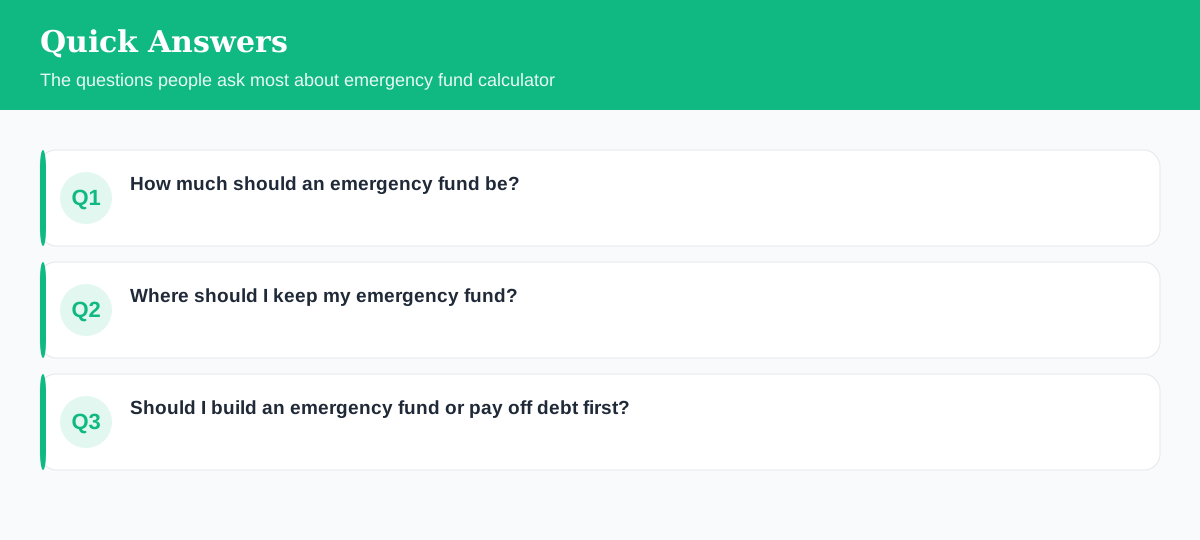
How much should an emergency fund be?
A common target is 3–6 months of essential expenses. If your income is variable or you have dependents, aim higher; a stable dual-income household may be comfortable at the lower end.
Where should I keep my emergency fund?
Somewhere safe and quickly accessible — typically a separate high-yield savings account. It shouldn't be invested in volatile assets, because you need it to be there exactly when markets might be down.
Should I build an emergency fund or pay off debt first?
Usually build a small starter fund (e.g. one month) first, then attack high-interest debt, then finish the full fund. That starter buffer stops a surprise expense from pushing you back into debt.
Explore 500+ Free Online Tools
No sign-up. No cost. Forever free — for developers, writers & creators.