 health
BMI, BMR and TDEE Explained: How to Use Them for Your Goals
If you have ever tried to lose or gain weight methodically, you have run into three acronyms: BMI, BMR and TDEE. They sound clinical, but each answers a simple question about your body, and together they form a practical foundation for any health goal. The trouble is that each one is also widely misused.
This guide explains what BMI, BMR and TDEE actually tell you, where each falls short, and how to use them together realistically. None of this replaces advice from a doctor or dietitian — think of it as the map, not the prescription.
BMI: a rough screening number
Body Mass Index is weight divided by height squared. It sorts people into underweight, normal, overweight and obese bands, and it is popular because it needs only two numbers anyone can measure.
That simplicity is also its weakness. BMI knows nothing about body composition. A muscular athlete and someone carrying excess fat can share the same BMI, because muscle weighs more than fat for the same volume. In our view, BMI is a reasonable population screening tool and a poor individual verdict.
Use a BMI calculator to find your number, but treat it as one data point. Pair it with a waist measurement or a body-fat estimate for a fuller picture.
BMR: your body at rest
Basal Metabolic Rate is the energy your body burns just to stay alive — breathing, circulating blood, maintaining temperature — if you did nothing but rest all day. It is driven mainly by your size, age, sex and muscle mass.
BMR matters because it is the floor of your calorie needs. Eating below your BMR for long stretches is a warning sign, not a strategy; your body needs that baseline energy to function. Most formulas (like Mifflin-St Jeor) estimate BMR from height, weight, age and sex, and a BMR calculator does the arithmetic for you.
TDEE: what you actually burn
Total Daily Energy Expenditure is the number that really matters for weight goals. It is your BMR plus everything else you do:
- Movement and exercise — from walking to the gym.
- The thermic effect of food — digesting meals burns energy.
- Non-exercise activity — fidgeting, standing, daily chores.
TDEE is your true maintenance level. Eat at your TDEE and your weight holds steady; eat below it and you lose; eat above it and you gain. Everything about weight management flows from this single number.
Using the three together
Here is the practical workflow I recommend:
- Check BMI for a rough sense of where you stand — then set it aside if you are very muscular.
- Find your BMR to know your energy floor.
- Estimate your TDEE by applying an activity multiplier to your BMR.
- Set a sensible deficit or surplus around your TDEE.
How big a deficit?
For weight loss, a deficit of about 300–500 calories a day is sustainable, producing roughly 0.25–0.5 kg of loss per week. It is tempting to cut harder, but aggressive deficits are difficult to maintain, cost you muscle, and often end in rebound eating. Slow and steady genuinely wins here.
For muscle gain, a modest surplus of 200–300 calories paired with resistance training is enough; larger surpluses mostly add fat.
Measurements that add context
Because BMI is blunt, I always pair it with a couple of measurements that account for where weight sits, not just how much there is. Body fat distribution matters more for health than total weight alone.
- Waist circumference. Excess fat around the abdomen carries more health risk than the same weight on the hips and thighs. A tape measure around the waist is cheap and surprisingly informative.
- Waist-to-height ratio. A simple, well-regarded check: keep your waist under half your height. It needs only two numbers and sidesteps BMI's muscle problem.
- Body-fat percentage. Harder to measure accurately at home, but even a rough estimate tells you whether a high BMI is muscle or fat.
Tracking the trend, not the day
Weight fluctuates daily with water, food and sleep, so a single reading means little. What matters is the direction over weeks. Weigh under consistent conditions — same time of day, same scale — and watch the trend line rather than reacting to every wobble. A number that is slowly moving the right way is success, even if today's reading jumped.
This is also why I treat the calculators as a starting point and let real results fine-tune the plan. If the math says you are in a deficit but the trend is flat for three weeks, the estimate needs adjusting — your true TDEE is simply different from the formula's guess.
The limits to keep in mind
These numbers are estimates, not measurements. Real metabolism varies between individuals, and activity multipliers are approximations. Use them as a starting point, then adjust based on what the scale and the mirror actually do over a few weeks.
And again: for any medical condition, medication or significant health change, talk to a professional. Calculators inform decisions; they do not make them.
The takeaway
BMI is a quick screen, BMR is your resting energy floor, and TDEE is the maintenance number your goals revolve around. Find all three, lean on TDEE for planning, and choose a modest, sustainable deficit or surplus rather than an extreme one. Start by running your figures through a BMI calculator and a BMR calculator, then let real-world results fine-tune the plan.
Frequently Asked Questions
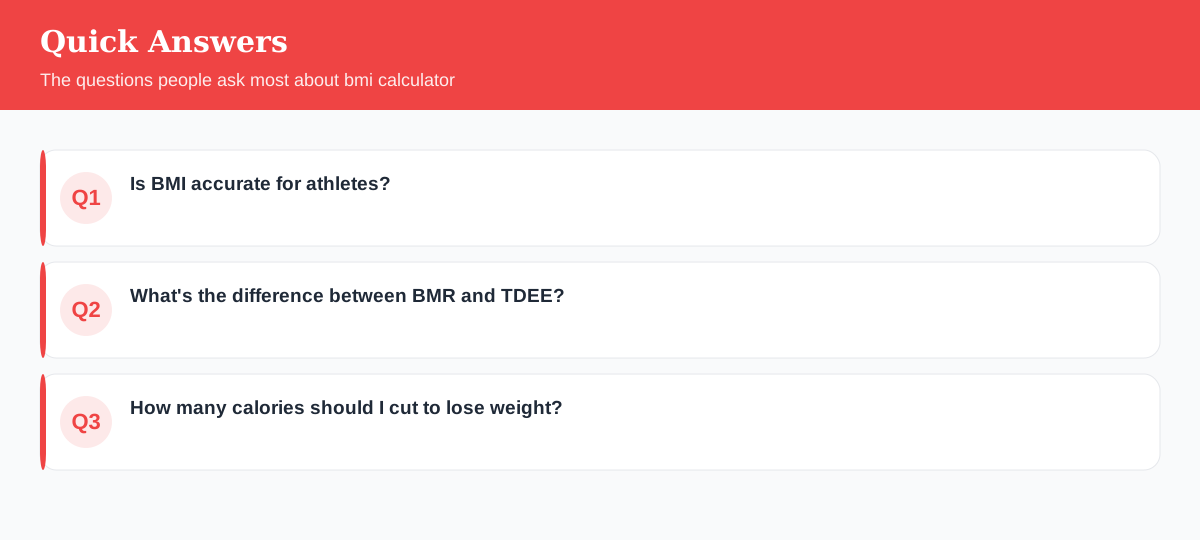
Is BMI accurate for athletes?
Not really. BMI only uses height and weight, so very muscular people can read as 'overweight' despite low body fat. Pair it with waist measurements or body-fat estimates.
What's the difference between BMR and TDEE?
BMR is the calories you burn at complete rest. TDEE is BMR plus everything you do — movement, exercise and digestion — so TDEE is what you actually need to maintain weight.
How many calories should I cut to lose weight?
A deficit of about 300–500 calories a day is sustainable for most people, giving roughly 0.25–0.5 kg of loss per week. Aggressive deficits are hard to maintain.
Explore 500+ Free Online Tools
No sign-up. No cost. Forever free — for developers, writers & creators.